

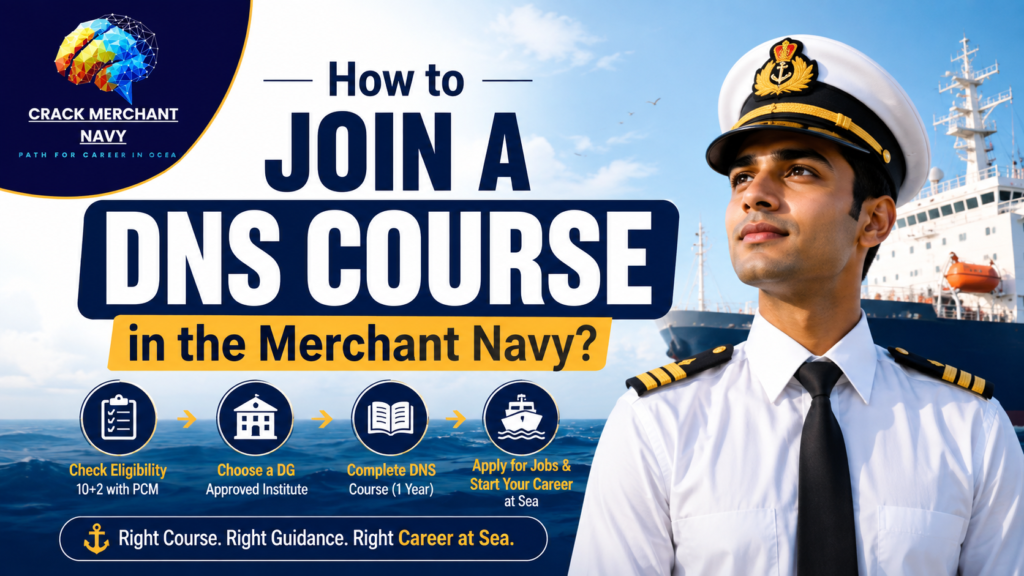
The marine industry is a magnet for young dreamers that want to cross oceans and visit different countries while making a living in the ocean. And so among many options to pursue this thrilling profession, DNS Course in Merchant Navy is one of the popular and systematic path for students on completing their higher secondary education. If you are thinking about how to pursue the join the DNS Course in the Merchant Navy, this detailed article will take you through all the relevant details of the course, including eligibility and admission procedure, fee structure and best institutes in simple and theoretical manner to help you decide on your maritime career.
What is the DNS Course in the Merchant Navy?
The DNS Course in the Merchant Navy is a 1 year pre-sea residential course, which is long a Diploma in Nautical Science, the residential training program is and it is approved by the Directorate General of Maritime Administration ( DGAM ), which was known as the Directorate general of shipping. This course is for students who have qualified 10+2 with Physics, Chemistry and Mathematics (PCM) and want to be a Navigating, or Deck Officer in merchant vessel.
Middle and senior level staff of the ship undergo the training in subjects like navigation, seamanship, ship stability, cargo handling, maritime law and procedures for safety of life at sea during the training course that combines classroom and practical education. At the successful completion of the oneyear program in DNS that cadet will be able to join merchant ship as Deck Cadet. Upon completion of 18 months of shore formal training and passing competitive examination conducted by the Ministry of Shipping, the candidates can obtain Second Mate Foreign Going Certificate of Competency (C.O.C), making them eligible for sailing as an officer in the international merchant ship.
The DNS path is also favored as it provides a quicker graduation from the Merchant Navy than the B Sc (Nautical Science) three-year degree but brings you the same officer career and certificate potential.
Who is eligible for the DNS Course?
Eligibility to apply for the DNS Course in Merchant Navy is the same everywhere i.e. DGMA Guidelines and will be followed strictly by the MTI which are recognized by DGMA. The main contenders are Indian nationals Who have cleared their 10+2 or equivalent examination with Science Stream.
You need to have done Physics, Chemistry and Maths as compulsory subjects in your 10+2 boards. Besides PCM, English should also be a subject in 10th or 12th grade with 50% marks as communication is essential for the maritime trade. Aspirants currently appearing for their 10+2 board examinations may also apply but they have to submit their final mark sheet before the start of the course.
B.Sc graduates with Physics as one of the subjects and B.E./B.Tech holders from qualified AICTE/UGC certified institutions along with 12th PCM students can also apply for the DNS program, however, they must fulfill the eligibility criteria of min. But most of the DNS aspirants are 12th science students who want to get a direct entry into the Merchant Navy.
What are the educational qualifications required for DNS admission?
The eligibility criteria for DNS admission are strict and non-refundable in order to confirm the cadets meet the basic educational make up required to provide “up front” training for the navigation school in a manner equivalent to training in a nautical environment. Minimum Eligibility: “Under the 10+2 (HSC) system you must have completed 10+2 from a Recognised board with Physics, Chemistry, and Mathematics as your core subjects.
In general, there is an aggregate of 60% required in PCM by most of the institutions/sponsoring companies, and in some cases, they may consider aspirants with 50% as well depending on their internal policies and the availability of seats. English is also an important subject and candidates are required to obtain minimum 50% marks in English in either 10th or 12th exams. This stress on English is because it is the language of the world for Marine Communication – Vital for safe navigation and working on a multi-national ships.
For B.Sc holders, the eligible candidates should have studied Physics, Mathematics, Chemistry or Electronics with Physics as a subject of study in one of the years, with an aggregate of 55% in the final year. Applicants with B.E./B.Tech degree need to fulfill DNS admission eligibility criteria. These opportunities permit those with engineering and science degrees to migrate into maritime careers via the DNS program.
It is relevant to note for aspirants that vocational streams/non-pcm backgrounds in 10+2 are not eligible to apply for the educational qualification requirements for DNS admission as the course is based on mathematical and scientific application for navigation & ship operations.
What is the age limit for joining the DNS Course?
Another important eligibility condition is the age limit that a candidate must fulfil in order to be eligible to apply for a DNS Course, this is important to keep the candidates physically and mentally fit at the high demanding sea life. The minimum age requirement for DNS program is 17 years as per DGMA rule, on the length of the course.
For General candidates, the maximum age limit is usually 25 years for male candidates, with relaxation in the age limit as per Govt. The upper age relaxation for OBC (NCL) is 28 years and for SC/ST is 30 years. For women, the upper age limit is marginally relaxed; it’s usually 27 years for General category, 30 years for OBC, 32 years for SC/ST as the maritime sector is considered as inclusive to gender.
The age reference date is generally announced by IMU or the training centre concerned and is usually linked to the commencement of the academic session (January or July of the year in which you have applied for the admission). Candidates must be falling within the specified age limits at the time of admission, as overage candidates are not allowed to take part in admission/ selection, and they cannot avail themselves of the benefit of their academic performance.
Is IMU-CET required for the DNS Course?
Yes, it is compulsory to appear in IMU-CET (Indian Maritime University Common Entrance Test) for DNS Course admission in India. In accordance with the DGS Training Circular 12 2020, the admission of these Institutes shall be done on the basis of the IMU-CET rank. This rule holds good for the IMU campuses, its affiliated institutes and even the non-affiliated DGS approved MTIs nationwide.
The IMU-CET, a national-level examination, is conducted by the Indian Maritime University and tests candidates in Physics, Chemistry, Mathematics, English and General Aptitude. A good rank in the qualifying IMU-CET is mandatory not just for getting admission in DNS courses but also for getting sponsored from the top shipping companies.
February 2027 DNS batch candidates have to ensure to appear for IMU-CET in May 2026 as IMU does not conduct different entrance examinations for different batches of the same academic cycle. So all preparation is very important for IMU-CET for those who want to join the DNS Course In The Merchant Navy.
What is the DNS Course admission process?
The admission procedure for the DNG Course is a stepwise process involving application for sponsorships, IUM-CET clearing, medical fitness, counseling, and seat allotment. Having a good understanding of this process can greatly increase the chances of an aspirant to get the admission in a good DNS institute.
The first thing you do is take an application for sponsorship exams from major shipping companies and maritime training institutes like Anglo-Eastern, Great Eastern, Shipping Corporation of India etc. These sponsorship schemes usually pay for the entire course fee and include a monthly stipend while providing sea training, and hence are highly sought after by aspirants. Candidates are required to fill in the application form carefully, submit the necessary documents and appear for written test and interview as per the company.
The second step is to register and appear for the IMU-CET examination which is the entrance test for all DGS approved DNS programs. Only those candidates who qualify the IMU-CET will be considered for counseling and seat allotment. Aspirants to participate in a consolidated counseling after the IMU-CET result is announced and they will be allowed to select an institute of their choice considering the rank and seats.
The third is a full medical is taken in a DGMA Accredited Medical Centre for fitness for seafaring. This includes eye, hearing, heart, and whole-body testing, as seafarers need to be in top shape for life at sea. At the end, when all the rounds are cleared, the candidates get the offers of admission from the allotted institutes and can join the DNS course.
What are the medical and eyesight requirements for DNS?
The DNS medical and vision standards are high to meet the demands of cadets being able to perform their duties on the sea without endangering themselves and others. All the applicants have to get medical examination from the medical units approved by DGMA.
Thousands of applicants apply every year, but the eye test is very tough. Candidates must forgo wearing contact lenses and other lens-wearing is prohibited for air force candidates with vision problems and who have 6/6 vision in each eye without any corrective lenses for dns jovens. In addition, colour-blindness is a must-fail, as the ability to tell the difference between nav lights, signal flags, and colours on electronic displays is essential to proper and safe operations of ships. A history of eye surgery such as LASIK may also be reviewed, and candidates are requested to check DGMA norms prior to that.
In addition to vision, the medical evaluation includes an assessment of an individual’s general health, including heart functioning, hearing capacity, lung function, and strength of the musculoskeletal system. Nominees shouldn’t have long-term diseases, physical disabilities, or anything that might hamper their ability to work in emergencies at sea. The validity of medical certificate obtained from the authorized center is time bound and in that duration, the certificate holder can affix his/her name to any amount of application forms.
If an individual fails to satisfy the DNS eyesight and medical needs then they will be excluded on the spot despite their good academic record and rank in the IMU-CET. So all the aspirants are hinted to get a preliminary medical test done before filling in the application to check whether they are eligible for the health standards.
What is the fee structure of the DNS Course?
The price for the DNS Course depends on the candidate obtaining a company sponsorship or a self sponsored seat from the private maritime institute. For self-funded participants, the overall course fees is generally in the range of INR 3 lakh to INR 6 lakh which includes tuition, accommodation, training materials and exam fees.
Yet sponsored candidates by some of the top shipping majors like Anglo-Eastern, Great Eastern or Sewa Shipping they end up getting the whole fee reversed, and they might be having a monthly stipend for the 18 months that they are training at sea. Sponsorship schemes are extremely competitive and candidates have to clear company based written tests, interviews and medical examination apart from IMU-CET.
Installments Some institutes provide the choice of paying in installments i.e., paying the fees in parts during the course of study. Some state governments and central schemes also offer loan reg or scholarships to deserving candidates from economically weakest sections, which could substantially ease out the financial burden.
It is advisable for the aspirants to check the fee details and sponsorship related terms with the institute/ company website directly as they might be revised from year to year as per regulatory directives and market dynamics.
Which are the best DNS institutes in India?
Several well-known institutes in India provide the DNS Course with good infrastructure, knowledgeable faculty and good industry ties for placements and sponsorships. Among the leading DNS Organisations in India are Anglo-Eastern Maritime Academy (AEMA) in Mumbai, Great Eastern Institute of Maritime Studies (GEIMS) in Lonavala and the Maritime Training Institute (MTI) of the Shipping Corporation of India in Powai, Mumbai.
Head to other leading institutes like Seven Islands Maritime Training Institute in Chennai, Euro Tech Maritime Academy in Kerala and BP Marine Academy in Pune – all of which are DGMA approved and affiliated to the Indian Maritime University. These institutes provide state-of-the-art simulators, laboratories with airconditioning and full-fledged training programs that meet international maritime standards.
While selecting an institute, aspirants should look at a few things including the placement records, sponsorship of the companies, the quality of infrastructure, expertise of the faculty, and strength of alumni network. Campus visits, chatting up current students and checking past placement statistics also can give a sense of the institute’s credibility and career services.
In the end, the best DNS institute for a candidate probably varies as per the person’s preferences and financial background and career aspiration, but it is important to note that opting for a DGMA recognized Institute having strong Industry reputation will be significant for a person’s growth in the Merchant Navy in long run.
Final Thoughts on How to join DNS Course in the Merchant Navy
Joining the DNS Course in Merchant Navy is a process-oriented that needs a lot of planning, academic preparation and physical fitness. Knowing about the eligibility criteria, admission procedure, medical standards and fee structures will help the aspirants to take an informed decision before applying and will also increase their chances to grab a seat in top DNS institute. With commitment and guidance, the DNS route can ultimately take you to a rewarding, high-growth career as a Deck Officer in the worldwide maritime industry.
Conclusion
If you are a young and ambitious who wishes to make a bright future in merchant navy then joining dns course in merchant navy is good opportunity for you. So, by having all these details regarding the eligibility criteria, educational qualification, age limit, entrance exam, admission process, medical standards, fee structure, and best institutes, candidate can start his/her career in maritime with an clear vision and strong hold fodder at hand. DNS Course in Merchant Navy not only lets you become a professional deck officer in merchant navy but also helps you to build a long & rewarding career that provides global exposure, lucrative lifestyle and not to forget continuous growth in the shipping industry. So, it’s safe to say that all “bean counters” (parents and students) are equally influenced by the prospect of a good career path and salary; and with the right attitude, some commitment, and the right school, any deserving student can make a great start on his or her journey through the DNS Course in Merchant Navy.